Exploration System
Rock physics · Petrophysics · Quantitative seismic

Reservoir properties, read directly from inverted seismic

Exploration System is the research site of Manzar Fawad. It presents rock physics and petrophysics models that turn well logs and inverted seismic into fluid saturation, shale volume, porosity, organic richness, source rock maturity and brittleness.

See the two research directions Open the web applications
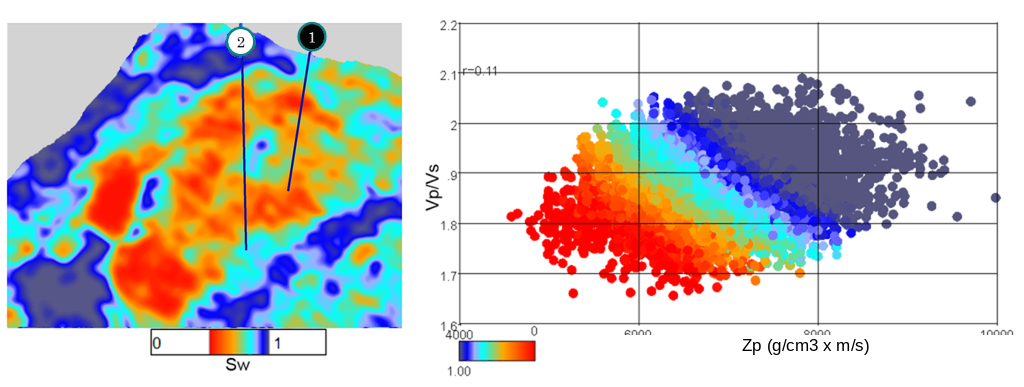
Water saturation map on a reservoir surface with two wells, and crossplot of acoustic impedance (Zp) against Vp/Vs coloured by water saturation
Fig. 1. Water saturation from prestack inverted seismic, draped on a reservoir surface, with the Zp versus Vp/Vs crossplot coloured by Sw. Well 1 was a discovery, and well 2 was dry. Map lightly smoothed for display.
Research directions

Two settings, one line of reasoning

Both directions rest on the same idea. A model is first calibrated where the rock is known, at the well, and is then applied where only geophysical data exist. What differs is the property of interest and the type of rock that carries it.

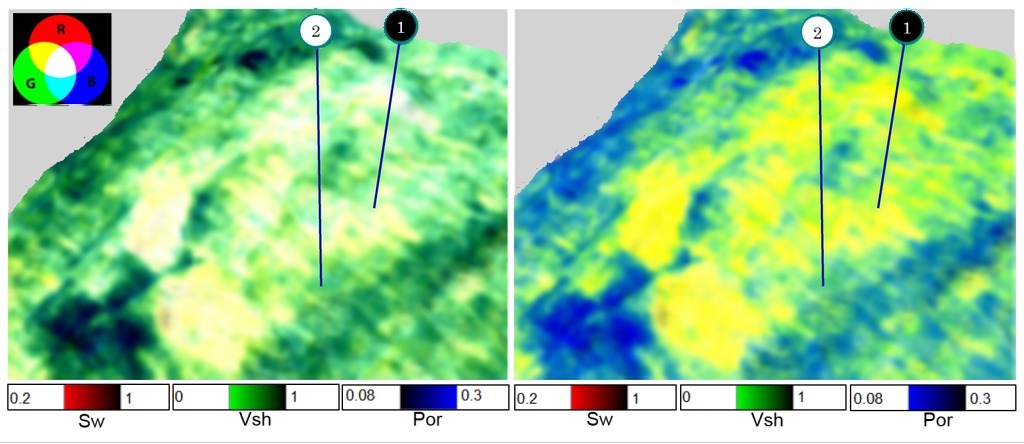
RGB maps combining water saturation, shale volume and porosity on a reservoir surface
01

Quantitative seismic screening for HC exploration and CO2 storage sites in mature basins

Models that convert acoustic impedance (Zp) and Vp/Vs volumes into fluid saturation, shale volume, porosity and brittleness, calibrated on nearby wells, so that hydrocarbon leads can be screened and ranked, CO2 storage sites characterised, and injected CO2 monitored over time.

  • Fluid saturation from Zp and Vp/Vs
  • Shale volume and porosity from the same elastic plane
  • Brittleness index written for prestack inversion outputs
  • Saturation from combined CSEM and seismic data

Fawad and Mondol (2021, 2022a); Fawad et al. (2020, 2021, 2026)

Read about seismic screening
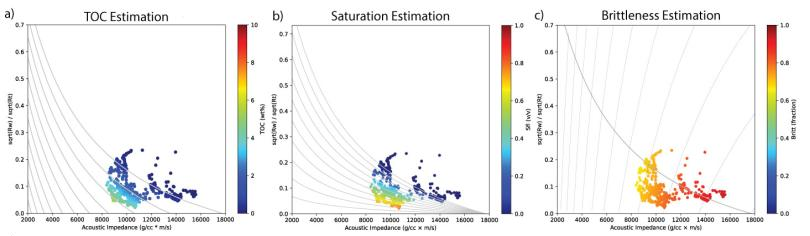
Three crossplot templates of acoustic impedance against the resistivity ratio function, coloured by TOC, saturation and brittleness
02

Unconventional reservoir characterisation

A petrophysics workflow that estimates total organic carbon, hydrocarbon saturation, source rock maturity and brittleness from standard wireline logs, and carries organic richness and brittleness into prestack inverted seismic to locate sweet spots.

  • Total organic carbon with uncertainty bounds, from sonic, density and resistivity logs
  • Source rock maturity from a normalized hydrocarbon index
  • Shale brittleness index from the same log suite
  • Rock physics templates for organic richness, brittleness and gas saturation

Fawad and Mondol (2022b); Fawad et al. (2026); Hansen et al. (2019); Davy et al. (2024, 2026)

Read about unconventional reservoirs
Model index

What each model takes in, and what it returns

Model Input Output Documented in
Fluid saturation, Zp versus Vp/Vs Prestack inverted Zp and Vp/Vs, calibrated on well logs Saturation of the target fluid (hydrocarbon or CO2) Fawad and Mondol (2022a); US 11,914,091 B2; NO 346572
Shale volume, Zp versus Vp/Vs Prestack inverted Zp and Vp/Vs, calibrated on well logs Shale volume Fawad, Rahman and Mondol (2021); NO 346488; US 2022/0236439 A1
Porosity, Zp versus Vp/Vs Prestack inverted Zp and Vp/Vs, calibrated on well logs Porosity, and effective porosity once shale volume is discounted Fawad, Rahman and Mondol (2021)
Brittleness index, Zp versus Vp/Vs Prestack inverted Zp and Vp/Vs, or the equivalent well logs Brittleness index from 0 (organic matter) to 1 (quartz) Fawad, Grande and Mondol (2026)
Saturation from CSEM and seismic Resistivity from inverted CSEM, Zp from seismic inversion Fluid saturation profile Fawad and Mondol (2021); US 11,725,510 B2; NO 346380
Total organic carbon from well logs Sonic, density and deep resistivity logs TOC in weight percent, as a mean curve with P10 to P90 bounds Fawad and Mondol (2022b); NO 345797; US 2021/0255358 A1
Source rock maturity Sonic, density and deep resistivity logs Hydrocarbon fluid saturation and a normalized hydrocarbon index Fawad, Mustaqeem, Harris and Mondol (2026); Fawad and Mondol (2021)
Shale brittleness index Sonic, density and deep resistivity logs Brittleness index along the well Rahman et al. (2022); NO 345798; US 2021/0255359 A1
Web application

Synthetic Vs Generator

Many wells lack a shear sonic log, and the seismic screening models depend on one. This tool turns a well log without shear data into a LAS file with a physically consistent synthetic Vs. The calculation runs entirely in the browser, so well data never leave the user's computer.

Open the application User guide All applications
Selected publications

Where the models are described

Full list of publications and patents
  1. Fawad, M., Mustaqeem, A., Harris, N. and Mondol, N.H. (2026). A new petrophysics workflow for unconventional reservoir characterisation. 87th EAGE Annual Conference & Exhibition, Aberdeen.
  2. Fawad, M. and Mondol, N.H. (2022a). Monitoring geological storage of CO2 using a new rock physics model. Scientific Reports, 12, 297. doi.org/10.1038/s41598-021-04400-7
  3. Fawad, M., Hansen, J.A. and Mondol, N.H. (2020). Seismic-fluid detection-a review. Earth-Science Reviews, 210, 103347. doi.org/10.1016/j.earscirev.2020.103347
  4. Hansen, J.A., Mondol, N.H. and Fawad, M. (2019). Organic content and maturation effects on elastic properties of source rock shales in the Central North Sea. Interpretation, 7(2), T477–T497. doi.org/10.1190/INT-2018-0105.1
  5. Davy, N., El-Husseiny, A., Fawad, M., Waheed, U.B., Ayranci, K. and Harris, N.B. (2026). Comparative study of optimized rock-physics templates (RPTs) and machine learning (ML) approaches for sweet spot delineation in shale gas reservoir. Unconventional Resources, 11, 100334. doi.org/10.1016/j.uncres.2026.100334

Manzar Fawad is a Lead Geophysicist at the Norwegian Geotechnical Institute (NGI) in Oslo. He holds a PhD in experimental rock physics from the University of Oslo and an MSc in Petroleum Geosciences from NTNU, and has worked across the oil industry, research, consultancy and academia.

About and contact